
Dark Winter: Designing a Survival Board Game

Dark Winter is a board game of survival, cooperation and resource management. Players play four survivors, living in a vulnerable house together during the pandemic and social collapse. They need to survive as long as possible by looting, using their resources and responding to threats and risks.
This game is in response to a creative exercise with the theme “We are all in this together”.
Contents
Inspiration
In 2001, a real-world exercise tested the emergency response to a bio-terror attack on the continental United States. The operation was called: Dark Winter. Within just a few days, the simulation spiraled out of control. The operation predicted a rapid breakdown in essential institutions, civil disorder and massive civilian casualties.
Dark Winter has revealed how vulnerable we’ve become. By the time patient zero feels the first sore throat, millions of people will already be infected. Just a few days after the pandemic, the power will fail, the shelves will be empty, and the taps will run dry. And once hunger and despair take hold, people will do anything for survival. Our complex world is primed for breakdown. And once the chaos strikes, there won’t be resources to save us all.
Rules
Goal: survive as long as possible.
Set-up
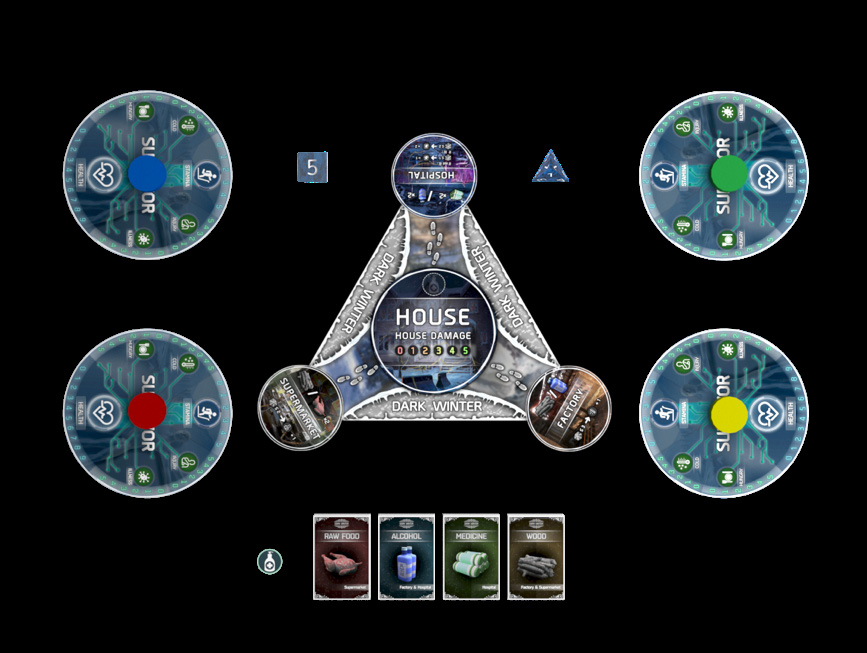
- Four players each have a character status card and a character marker representing their actions.
- Players can use paper clips to mark the status values on the character status card.
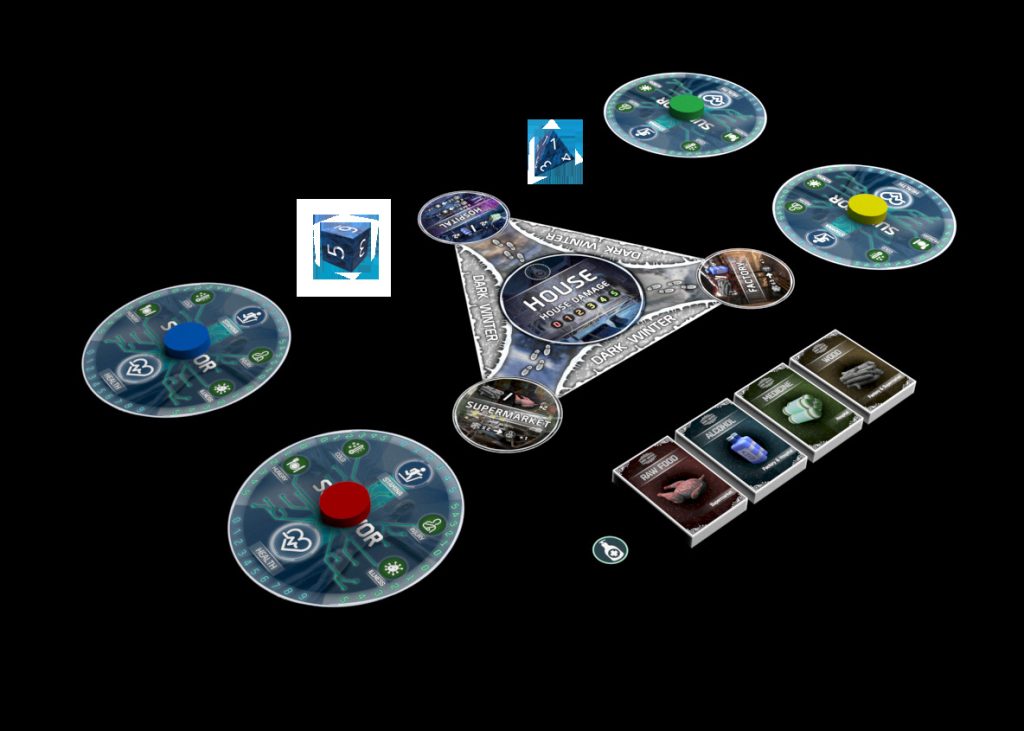
- Place the board in the middle of the table.
- The house damage marker is used to mark the house damage of 0-5 on the location board.
- The disinfection marker is used to mark the disinfection status of the house on the location board.
- Four kinds of resource cards are stacked on one side of the location board as the resource generation area, and the other side of the location board is used as the resource storage area shared by all players.
Character status
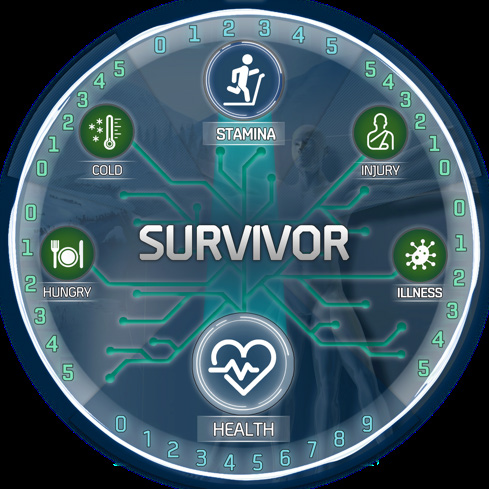
| Status | Range | What it is |
|---|---|---|
| Health | 0-9 | The physical health of the character. |
| Stamina | 0-5 | The action points of the character. |
| Cold / Hunger / Illness / Injury | 0-5 each | Negative status of the character. |
When the character’s health reaches 0 or the cold / hunger / illness / injury is higher than 5, the character dies and quits. When the character dies in the house, the resource storage area adds 4 units of raw food.
Locations
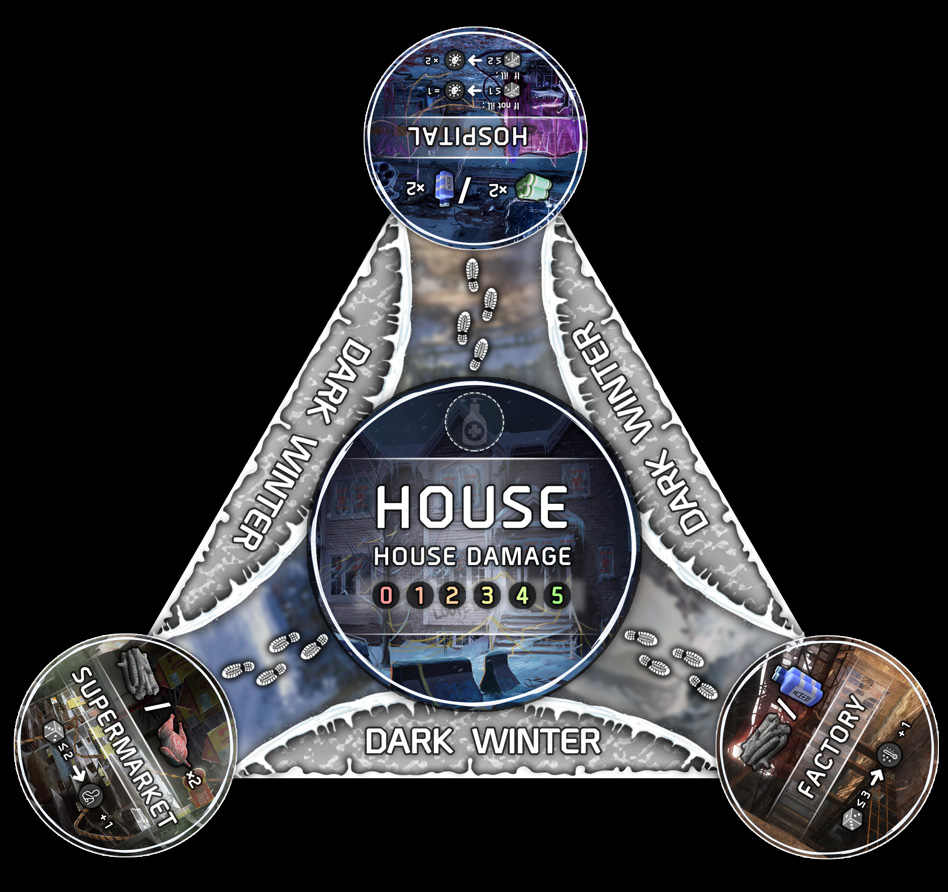
- The locations in the game include the house where the survivors (characters) live and three locations to explore.
- The status of the house: the degree of house damage (0-5) and whether it is disinfected.
- Each of the three explorable locations has its own resources and risks, which will be explained later.
Resources
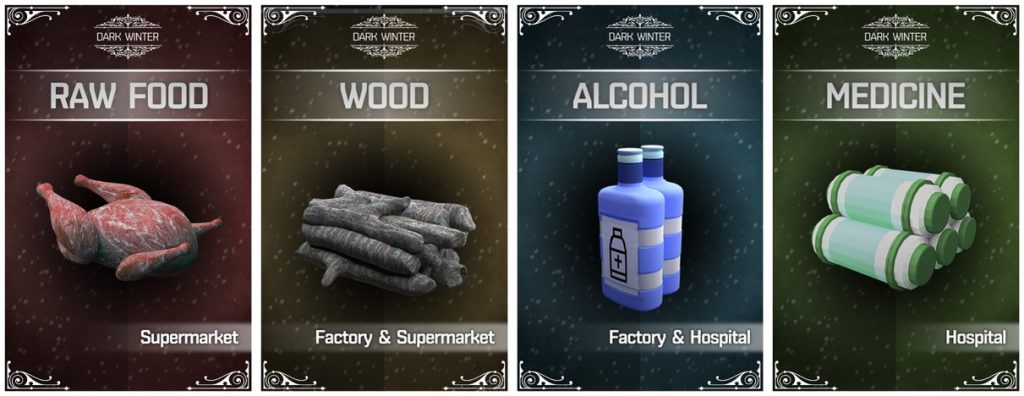
- There are four kinds of resources in the game: raw food, wood, alcohol and medicine.
- When using resources, move the corresponding resources from the resource storage area to the resource generation area.
- When looting for resources, the corresponding resources should be moved from the resource generation area to the explorable location, and in the evening phase moved from the explorable location to the resource storage area.
- When trading resources with neighbors, the obtained resources are moved from the resource generation area to the resource storage area, and the paid resources are moved from the resource storage area to the resource generation area.
The round
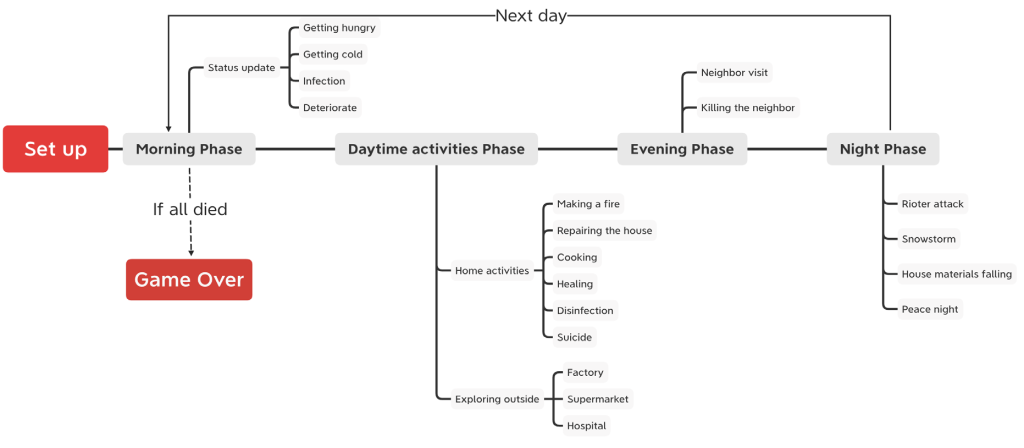
Every round represents a day for the survivors. Each day has the following phases:
- Morning phase
- Daytime activities phase
- Evening phase
- Night phase
Morning phase
Steps of this phase:
- Getting hungry: for all characters, hunger +1.
- Getting cold: for all characters, cold +house damage.
- Infection: for each character who is ill, each other character who is not ill rolls the dice once. If the result is ≤2 (if the house has been disinfected: ≤1), he will be infected (illness becomes 1). Reset the house to be undisinfected.
- Deteriorate: for each character who is ill, his illness +1, but players can choose to consume medicine (medicine -1) to stop the illness growth of the day.
- Rested: health of each character is set to “10 – Cold – Hunger – Illness – Injury”, and the character dies when the health is ≤0. Stamina of each character is set to health / 2 (rounded up).
Daytime activities phase
In this phase, players can choose to stay in the house or go out to explore; they cannot do both in a day.
1. House activities. In turn order, players who stay in the house can carry out any of the following activities, and the stamina of the character will be consumed (stamina -1) for each activity.
| Activity | Effect | Resource consumption |
|---|---|---|
| Making a fire | For all characters staying in the house, cold will be cleared (cold = 0) | Wood -1, alcohol -1 |
| Repairing the house | House damage -1 | Wood -1 |
| Cooking | For all characters staying in the house, hunger -1 | Raw food – number of characters in the house, wood -1, alcohol -1 |
| Healing | For the character carrying out this activity, his injury -2 (until 0), but he can’t do any other activities in the day | Alcohol -1, medicine -1 |
| Disinfection | The house becomes disinfected | Alcohol -1 |
| Suicide | The character who carries out this activity dies | – |
2. Exploring outside. Players can choose a location to explore, and they can loot for resources multiple times (if they have enough stamina). Every time they loot, their stamina is consumed (stamina -1), and there are risks of looting: players roll dice once every time they loot, and if the results meet the corresponding conditions, they will be punished.
| Location | Lootable (choose one option) | Risk of each loot |
|---|---|---|
| Factory | wood / alcohol | If dice ≤3, cold +1 |
| Supermarket | raw food x2 / wood | If dice ≤2, injury +1 |
| Hospital | alcohol x2 / medicine x2 | If dice ≤1: for a character who is not ill, infected (illness becomes 1); for one who is ill, illness doubled (illness x2) |
At the end of exploration, if the character is not ill, roll the dice twice. If both times are ≤2, the character will be infected (illness = 1).
Evening phase
Neighbor visit: provide random resources with their quantity equal to the number of surviving characters. The types of resources are determined by rolling four dice (1: raw food, 2: wood, 3: alcohol, 4: medicine). Players can exchange the same number of resources in the resource storage area.
Killing the neighbor: players can choose to kill the neighbor when the neighbor visits. They can get all the resources provided by the neighbor and 4 units of raw food (directly into the resource storage area) for free, but cancel the neighbor visit in the following game process.
Night phase
Roll a D4 dice to determine which one of the following four night events happens.
- Rioter attack: players can choose:
- A. House damage +1, at least two players’ stamina -1 and injury +1 (if at least two players have stamina left).
- B. Lose half of their resources (the resources in the resource storage area become the previous resources / 2, rounded down).
- Snowstorm: house damage +1, for all characters, cold +1.
- House materials falling: for all characters, injury + (1 + house damage / 2 (rounded down)).
- Peace night: nothing happens.
Designing Dark Winter
It’s difficult to analyze your own game, because as a designer, you can see deep enough to reach the essence and purpose of the design, but you can’t see comprehensively enough from every perspective (that’s why we need playtests when designing games). Therefore, this analysis is more about how I designed this board game, specifically about my understanding of the theme and the design goals.
“We are all in this together”
Two key points that can be extracted from this theme are “in this” and “all together”. “In this” means that the game needs an environment element, and the core gameplay needs a dynamic environment as the basis, so the gameplay can’t just be the interaction between players. We can give players the perception of “in this” through the attributes of the environment and the interaction and correlation between players and the environment. “All together” means that the gameplay of all players must be relevant and consistent, so I decided to create the relevance and consistency among players through shared status or resources and unified game goals. After the above analysis, I defined part of the design goal of my game: make survival and cooperation the keynotes of the game dynamics.
Inspiration and experience as design goals
As for the backstory of the survival game, I am inspired by the COVID-19 pandemic that we are all experiencing now. In 2001, there was a real exercise on emergency response to the pandemic of deadly infectious diseases — Operation Dark Winter. This operation showed that our society will collapse rapidly under the attack of a highly infectious and deadly virus, and the shortage of resources will make our social environment rapidly collapse into chaos.
Therefore, as survivors living in the environment of social collapse caused by the pandemic, the player has to face the difficulties of survival, the choices forced by dilemmas and the test of human nature. These experiences become design goals.
Game system and mechanics
Positive feedback. In the design of the core mechanics of the game, I chose to use positive feedback as the basic drive, that is, the loop keeps pushing the situation further in one direction. In my game, the ability of players to gain resources comes from the character status, and recovering the character status consumes resources. With some additional resource consumption and status deterioration, the game process will eventually go in a bad direction: specifically, in the later stage, the players’ resources become less and less, resulting in the status getting worse, and the poor status makes the players unable to gain resources, which ends the game. At the same time, the basic mechanics of positive feedback will gradually enlarge the effect of players’ decisions. This creates the pressure of survival and strong feedback on the player’s own behavior.
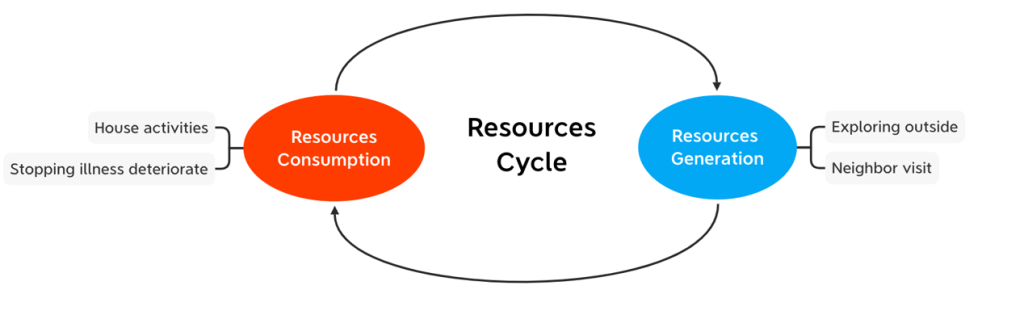
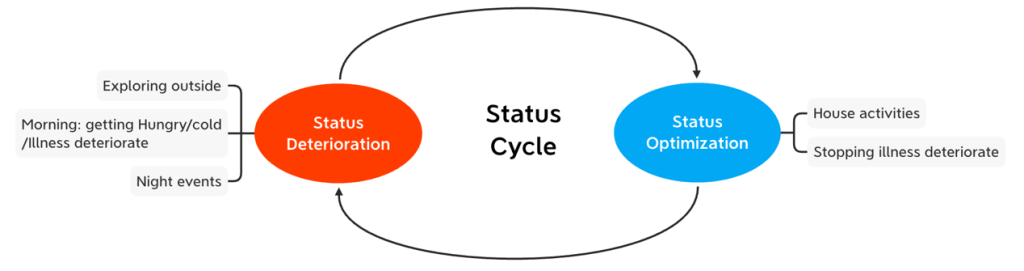
Resource and status sharing. The design of resource sharing is an important part of players’ perception of the environment and experience of “together”. The players need to maintain and use the shared resources in the game. That delivers the consistency of the game goals and motivations of the players, as well as the environment-oriented interaction. Status sharing specifically includes house damage and disinfection. The status of the house will significantly affect the players’ status in gameplay, and many positive effects will be applied to other players at the same time when the player carries out house activities, which gives players the experience of cooperative gameplay and the concept of win-win among players.
Emotional experience by some details of small mechanics. In addition to the main game mechanics that drive the game, some small mechanics and options designed for some specific game situations can provide dramatic game dynamics, enrich the content of the game and deliver impressive game experience.
For example, riot attack at night is a mechanic with great potential impact. When players take risks and don’t reserve stamina to deal with riot attack, they will lose a lot of resources, which will suddenly interrupt the continuity of the game and deal players a great emotional blow of frustration.
Another example is that in the later stage of the game, players are in a positive feedback cycle of accelerated deterioration, and they need additional resources to save themselves from the bad situation of almost the end of the game. Suicide to sacrifice provides such an option. After the character dies, he will provide a lot of food (from his dead body) for other players. The mechanic of extending the survival time of other characters at the cost of one character’s death and one player quitting the game makes players fall into the ethical dilemma of “the trolley problem”.
These small mechanics may play a more significant role in providing emotional experience than the core mechanics.
Playtests and updates
| Date | Version | Players | Play time | |
|---|---|---|---|---|
| Test 1 | February 23, 2021 | Prototype 1 | Yuhang Xing, Yexiang Zhou | 10 turns, about 90 mins |
| Test 2 | February 25, 2021 | Prototype 2 | Xueyan Wang, Yexiang Zhou | 6 turns, about 55 mins |
| Test 3 | March 1, 2021 | Prototype 3 | Jiancheng Zhu, Yuchen Yao, Yuhang Xing, Yexiang Zhou | 11 turns, about 77 mins |
Test 1
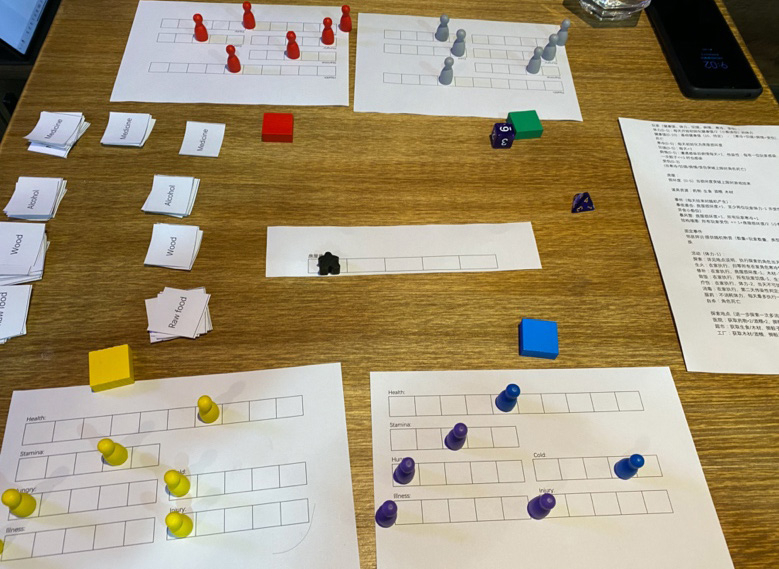
Findings and thoughts
- The core game mechanics are basically positive feedback.
- When players’ status is too difficult to recover, the situation deteriorates rapidly.
- When encountered rioter attack and not prepared to defend (not enough stamina reserved), players had a strong sense of depression and crisis for losing resources (this fits the experience of design goals).
Areas that could be improved
- The phase of hunger increasing is not clear, which affects the calculation of health.
- It is not convenient to use “chess pieces” to mark the status, because they are easy to be knocked down.
Suggestions from players
- The limitation of two units of stamina for healing makes players unable to heal when they are in poor status, and it is counter intuitive. It’s better to remove the stamina consumption for healing.
- Mechanics that can be added: characters will generate raw food after death (it means others can eat the body of dead man). This kind of benefits can give players motivation to sacrifice.
Update 1
- Props update: redesigned the character status card and added the location board.
- New mechanics: “Morning phase”, used to update the status of characters before calculating health and stamina.
- When the character dies, he will generate two units of raw food, which fits the emotional experience of the game backstory and gives players the motivation to sacrifice.
- Remove the 2 units of stamina requirement for healing and add the alcohol consumption. And the injury recovery from healing is “-2”, so as to increase the benefits to balance the cost of inactivity for a day.
- Add “Peace night” into “Night events”.
- Move medication taking from “Daytime activities” to the “Morning phase”, to make the rules clearer and easier to understand.
Test 2
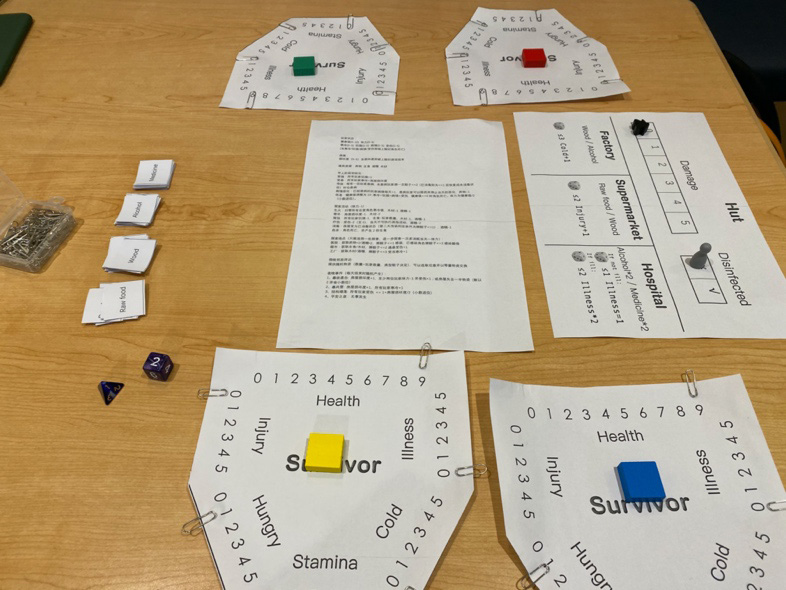
Findings and thoughts
- At the beginning, players chose not to reserve stamina for the rioter attack at night, and they got attacked on the first night, which led to the shortage of resources in the early time. And it makes the survival time in this playtest very short.
- Because of the shortage of wood, the house cannot be repaired for a long time, and players were suffering cold for long, causing a very negative situation for them.
- For most of the time, medicine is useless, because nobody is ill.
Areas that could be improved
- Increase the quantity of raw food can get in supermarkets, because hunger increasing for every day will lead to great demand of food.
- Reduce the consumption of wood for repairing house, because wood is lack in later stage.
Suggestions from players
- Add the chance of getting illness in factory and supermarket, to increase the opportunity of usage of medicine and infection mechanics.
- Add new use of medicine to increase the opportunity of usage of it at early stage.
Update 2
- Reduce the wood consumption for repairing house, from 2 to 1, to increase players’ decision spaces and reduce the difficulty in the later stage.
- Increase the quantity of raw food can get in supermarkets from 1 to 2, in order to balance and meet the long-term and large amount of food demand. At the same time, increase the quantity of raw food generated by dead body from 2 to 4, to balance the benefits of death proportionally.
- Change the resource consumption of healing from alcohol -2 to alcohol -1 and medicine -1, so as to add new use of medicine and give players motivation to go to the hospital at early stage.
- Change the injury effect of house materials falling from “1 + house damage / 2 (round up)” to “1 + house damage / 2 (round down)”, to prevent high punishment in the early stage of the game.
Test 3
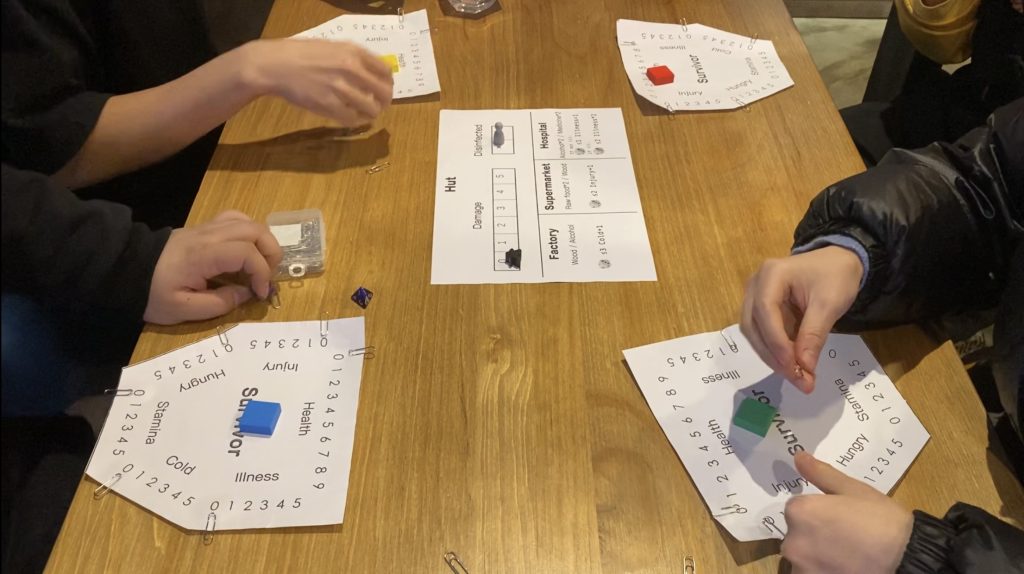
Findings and thoughts
One character committed suicide on the seventh day because he was in poor condition (lack of supplies, unable to survive in the next day, and the illness would be the risk of infecting others), and generated four units of raw food, which kept others alive for the next day. In the later stage, players had to kill the neighbor to get more resources, because they didn’t have enough health and stamina for the next day’s looting.
Areas that could be improved
Execute house activities first, to prevent the players at home from making decisions according to the experience of the players exploring outside.
Suggestions from players
- Let characters can kill the neighbor to get 4 points of raw food, for providing more choices.
- Enrich the content of the game by: random mission, characters’ skills, personal goal.
- Staged reward (in the 5th day or the 10th day for example) can be added as a short-term goal to drive players.
Update 3
- Add the infection mechanics for characters exploring out of house, to increase the opportunity of illness and related mechanics to take effect at early stage. The condition is rolling the dice twice, if both ≤2, get infected (means have chance of 1/9 to get infected).
- Add mechanics of killing neighbor. Players can choose two of them to “stamina -1 and injury +1” when the neighbor visits, and they will get 4 units of raw food and all the resources provided by the neighbor, the neighbor visit will be cancelled in the game process from then on.
- Visual art design of props.
The design document
The whole thing as it was handed in: the cover, the rulebook, the three test reports and the flow diagrams, seven pages.
- Dark Winter design document (PDF, 2.0 MB) – all seven pages.
- Rulebook (PDF, 1.0 MB) – pages 1 to 3 on their own.
- Playtest notes (PDF, 0.7 MB) – pages 4 to 6 on their own.